I have read that study of the emotion called “awe” has become a hot topic these days, at least among people who study emotions (who knew there are “scholars of awe?”). Do a Google search on “awe” (or “awe walks”) and you will find numerous articles like one by Emma Stone, PhD, “The Emerging Science of Awe and Its Benefits: New research is exploring the vast potential awe holds for self and society” in Psychology Today (April 27, 2017). Dr. Stone begins as follows:
“Seek out experiences that give you goosebumps. Such is the advice of Dacher Keltner, one of the foremost theorists and scholars of awe, a long-overlooked emotion. ‘What the science of awe is suggesting is that opportunities for awe surround us, and their benefits are profound,’ Keltner explains. Recent studies exploring this complex emotion have discovered compelling connections between the experience of awe and enhanced critical and creative thinking faculties, improved health, a sense of embeddedness into collective folds and an increase in pro-social behaviors such as kindness, self-sacrifice, cooperation, and resource-sharing. Awe is also one of the few emotions that can reconfigure our sense of time and immerse us in the present moment.”
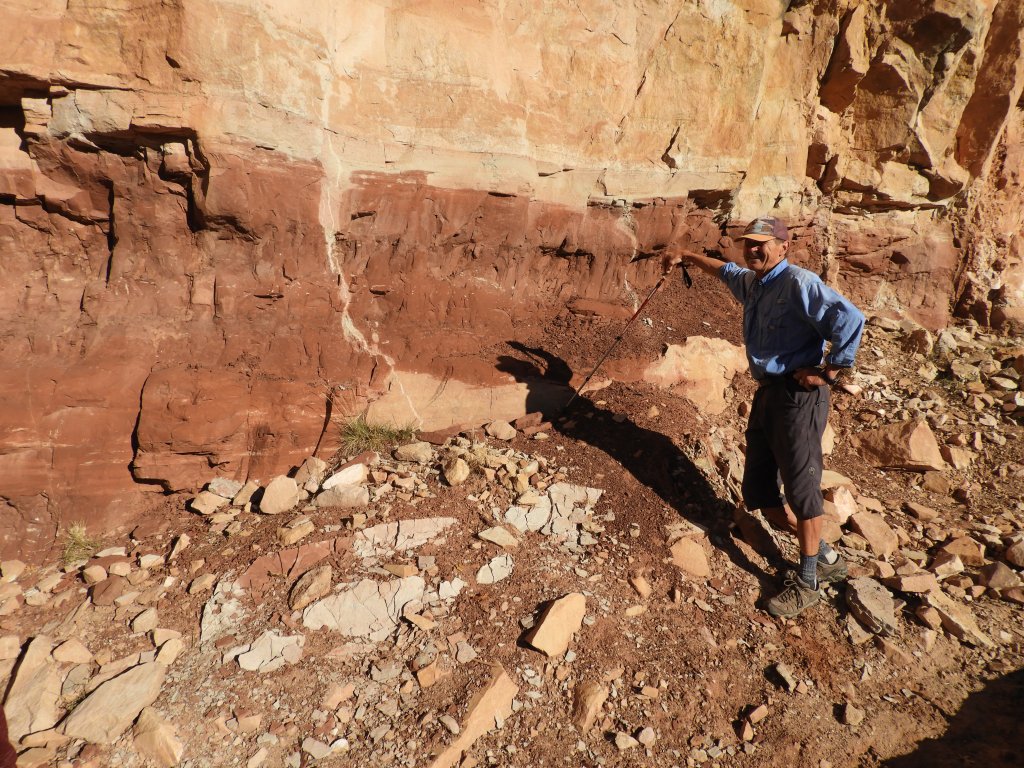
About three out of every five articles I found specifically mention seeing the Grand Canyon as an experience that evokes awe. During the so-called “taper” phase of preparing for my fall 2018 marathon, I got to participate in a four-day “Geology of the Grand Canyon” backpacking trip, organized by the Grand Canyon Field Institute and led by geologist Andre Potochnik, PhD. It was, indeed, packed with awe.
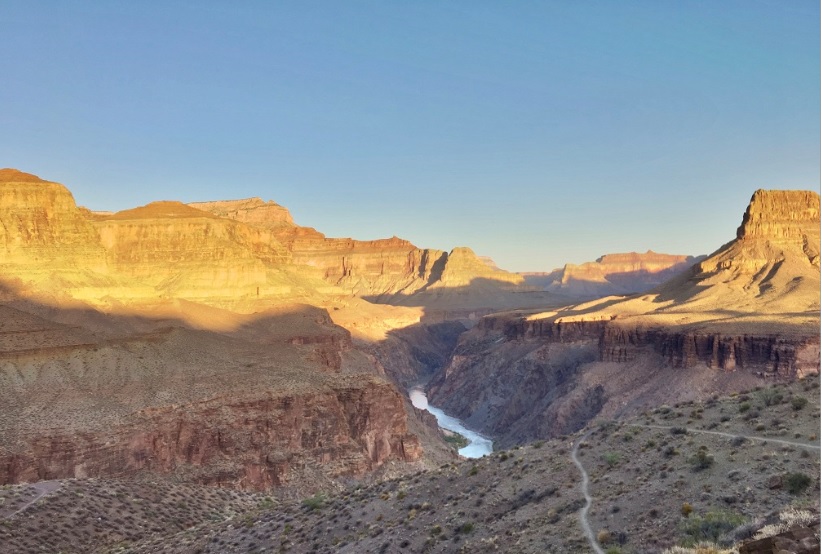
Distance runners seem have a special attraction to going down into the Grand Canyon, especially to the one-long-day, rim-to-rim-to-rim version, based on the surprisingly large number of running friends I know who have done this, want to, or have done it and want to do it again. Meghan P., a world-class runner, drove out there this winter and ran solo from south to north rim and back, most of it probably quite fast. Eric J., another great runner, did it recently with a couple of friends, sort of half-and-half running and hiking (as I recall he told me). Cristin and Janice and friends did it last fall and Cristin has already gone back again.
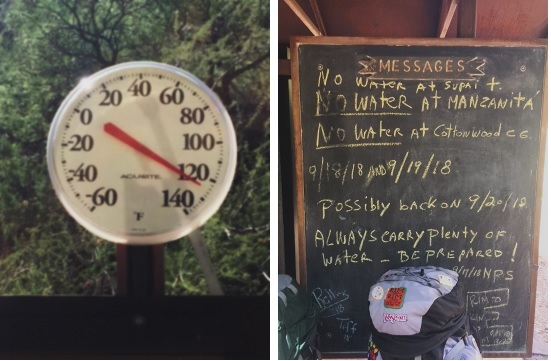
The only running I did in Grand Canyon Park was on the south rim, at first light of day just before the trip started. (Memorable from that run was that I almost ran smack into a massive elk who was grazing along the trail. Fortunately, she must have been quite familiar with stupid human tourists and did not seem to mind.) However, the fitness I had from my running hobby was a key factor that made it possible for me to learn so much and find so much joy and awe during those four days. The other folks on the trip were, for the most part, wasted during or by the end of the main day hikes. I, in contrast, was able to take advantage of every opportunity to ask questions about geology, Colorado River and Arizona water policy, etc., and to go on every additional short and long hike that time allowed. (I drained the batteries in my headlamp with my night-time looking-for-tarantulas walk on the canyon floor and my add-on hikes to see Anasazi artifacts, sunsets and moon rises, etc.) I had expected that my backpack would get progressively lighter during the trip as I ate through my food but ended up continually adding the heaviest group gear I could get my hands on, along with personal items from other people’s packs. Still, there remained a huge difference in my need to take breaks during the hike back out of the canyon and that of the other group members (especially a woman whose sister persuaded her to go with her on this trip, who stated with ever increasing frequency and loudness that she would NEVER forgive her sister for that).
The idea for my trip began when I found myself needing to do a lot of treadmill running and, to ease the associated boredom, experimented with using my iPad to watch a Great Courses® lecture series, “How the Earth Works” by geology professor Michael E. Wysession. This was not the perfect antidote because the treadmill is powerfully boring, but it helped a lot. I became even more interested in geology and moved on to reading Stephen Marshak’s textbook, Essentials of Geology, cover-to-cover over the course of months and coming up with the idea of planning a series of vacation trips to great “geology places.” The Grand Canyon was the first. The next was supposed to have been a trip centering around “volcano stuff” in the Pacific northwest in May of 2020, beginning with a downhill marathon on Oregon’s Mt. Hood, then with stops at Crater Lake and Mt. St Helens National Parks, but the pandemic cancelled all of that.

Though my travel adventures have been on hold, I have been discovering more and more awe on my Minneapolis area runs, which expanded to a lot of places I had never been pre-pandemic. New routes and old routes run repeatedly resulted in “being in the right place at the right time” to witness so much in nature or “the works of humans” that was interesting, beautiful, and/or awe-inspiring. For example, I have never so well appreciated as I have this year the explosive nature of spring. Since I see some places very regularly on runs or recovery walks, I now understand that trees produce, out of thin air, tons of leaves, flowers, seeds, and life force, almost overnight.
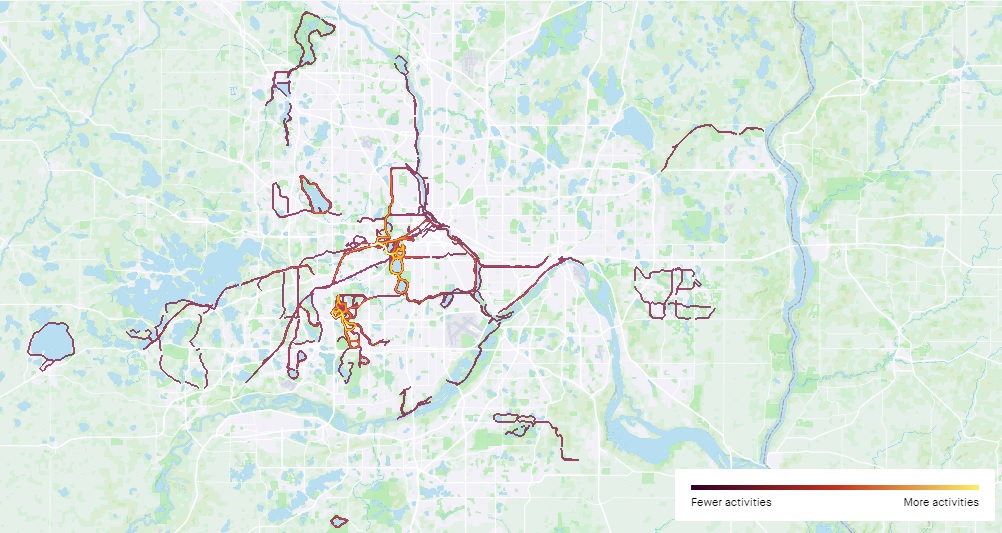
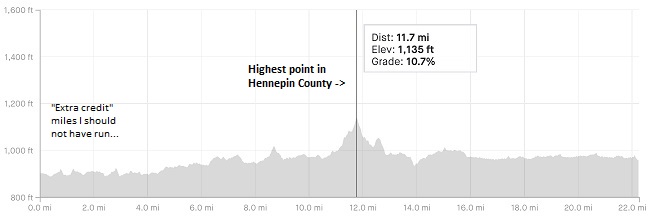
Two days ago, I went on my longest run until Grandma’s Marathon. This was a group run, 22 miles long and up and over the highest point in Hennepin County, Minnesota. This high point did not itself provide much of a view, due to lots of trees blocking the view. My awe on this run, as on so many group runs, was from the experience of being with a group of people who were enthusiastic, open, and kind. So often groups of runners seem to settle into a “tribe-like” mode that seems primordial, somehow like I think ancient humans may have routinely behaved longer ago, even, than we have had cell phones. Most or all these folks are much better runners than me who could have chosen to speed ahead, but they kept their speed down, waited for me to catch up when necessary, were friendly and supportive. On this run, and more extensively on the many preceding group runs just because there have been so many, I have had rich opportunities to gain insight into “the human condition” as lived by others and their very often awe-inspiring choices and accomplishments.
So, I have touched on awe experiences: a) that are made possible or at least richer by the fitness resulting from running, b) that result by chance from being outside moving through a wide variety of different places and/or the same places at different times of the year, and c) that relate to the temporary bonding of runners on a group run and the chances to learn important things about their lives. An additional category of awe experiences relates to my own human body, not anything I personally take credit for, but its amazing powers and capabilities, despite my not being a particularly good example of the species. I will leave that for a future blog entry.
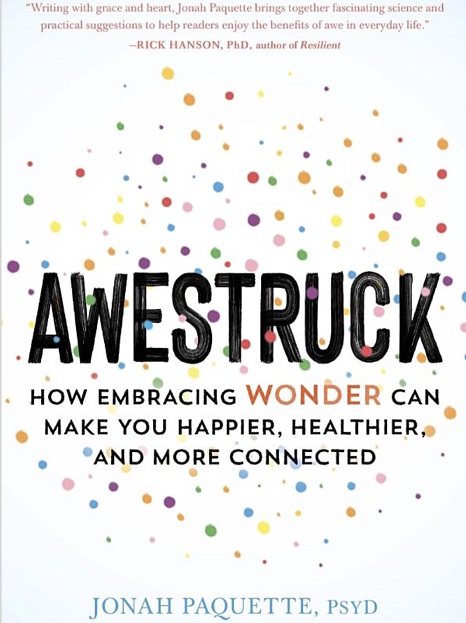
In hopes of learning more about this “long overlooked” and “complex” emotion, I started a free trial of Audible.com and downloaded the book, Awestruck, by Jonah Paquette. My plan is to try to listen to it during the long and possibly bumper-to-bumper drive up to Duluth the day before Grandma’s Marathon.
 Happy Aging Runner
Leave a comment