Three weeks before the race I suffered hamstring re-injury about seven miles into a Saturday morning group run. Same body parts I injured in March, but this time I am having a much harder time coming back.
I stopped running that morning as soon as I figured out that I had hurt myself. The organizer, Mike, who had been following along on his bicycle, very kindly sped back and brought his car to give me a ride, so I only had to walk a couple of miles to get back to my own car. Rick, a very experienced member of the group, was in the parking lot when I got back, having already finished a (planned) shorter version of this run. Rick advised, “Just rest until Grandma’s. You should be fine!” Mike added, “The hay is already in the barn” by which he meant that, even without the injury, there would be little gained from training in the days remaining and little lost from not training. I am an optimistic person, so I thought, “A ‘Hail Mary’ strategy like that might work. If not, I should be back happily running soon, maybe sooner than if I had to recover from running a marathon – and being able to run again soon is way more important to me.” Alas, two months later, I am still unable to run. I miss it terribly.
Grandma’s Marathon registrations had been capped at 4,000 runners and filled quite early. The official results show 2,777 finishers, so at least 1,223 of the 4,000 (31%) registered, like me, did not finish (the true percentage was even higher because some who registered ended up transferring their registration to another person who did run). Online race information does not include total number of registrants or starts. However, since there were 6,367 finishers in 2019, at most, 20% of those registered did not finish (this assumes they had a full registration of 8,000 in 2019, which I do not think was the case).
Online race information also does not include how many runners started running the race but did not finish. My guess is that this was no more than a few percent, based on the published study (see my previous post) of all starters in six large marathons over ten years (60 marathons) which found the percentage of starters who dropped out was well below 5% in all but the three races with the highest average temperature. Despite reasonable concern that it might be extremely hot and humid, the weather in Duluth on June 19,2021, was just about as good for running as you could hope. It appears, therefore, that well over a quarter of those who signed up for Grandma’s 2021, like me, did not make it to the starting line – a significantly larger fraction of those registered than in previous Grandma’s marathons. These likely included many who were unable to run due to injury, which is a well-recognized problem with marathons.
I did travel to Duluth for the race day, even though I knew I could not run. As I joined spectators at various points in the race and walked along Duluth’s beautiful Lakewalk, I wondered how many of the people I saw doing the same had dropped out because of injury.
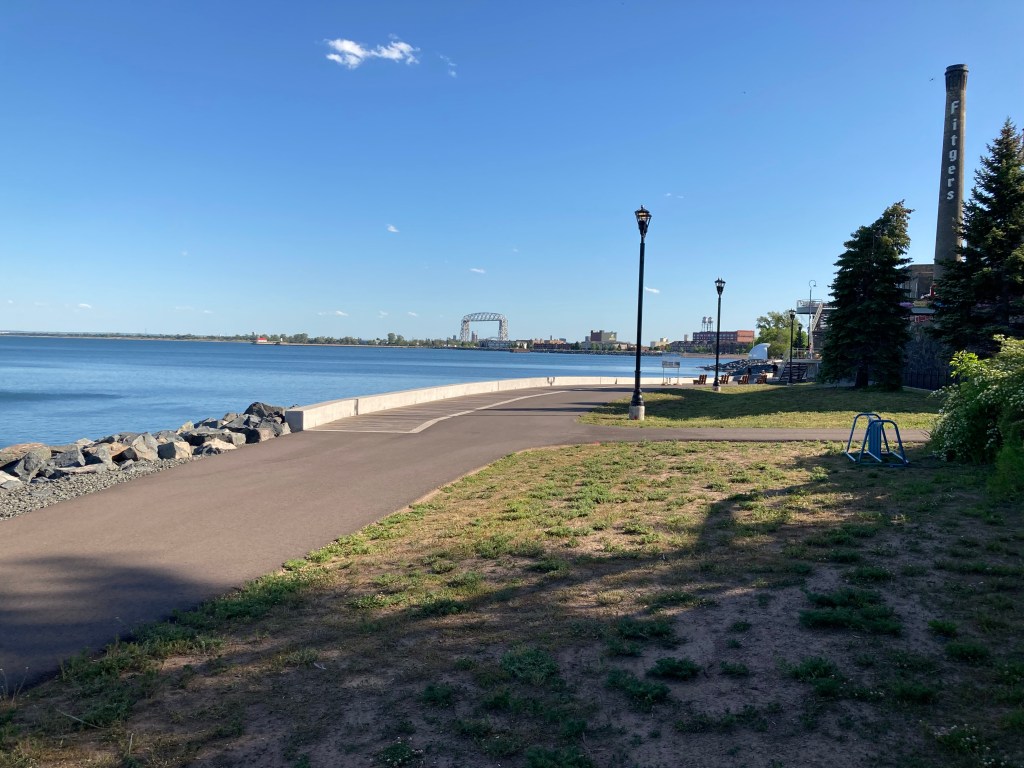
Duluth’s “Lakewalk,” a beautiful path along the Lake Superior shoreline.
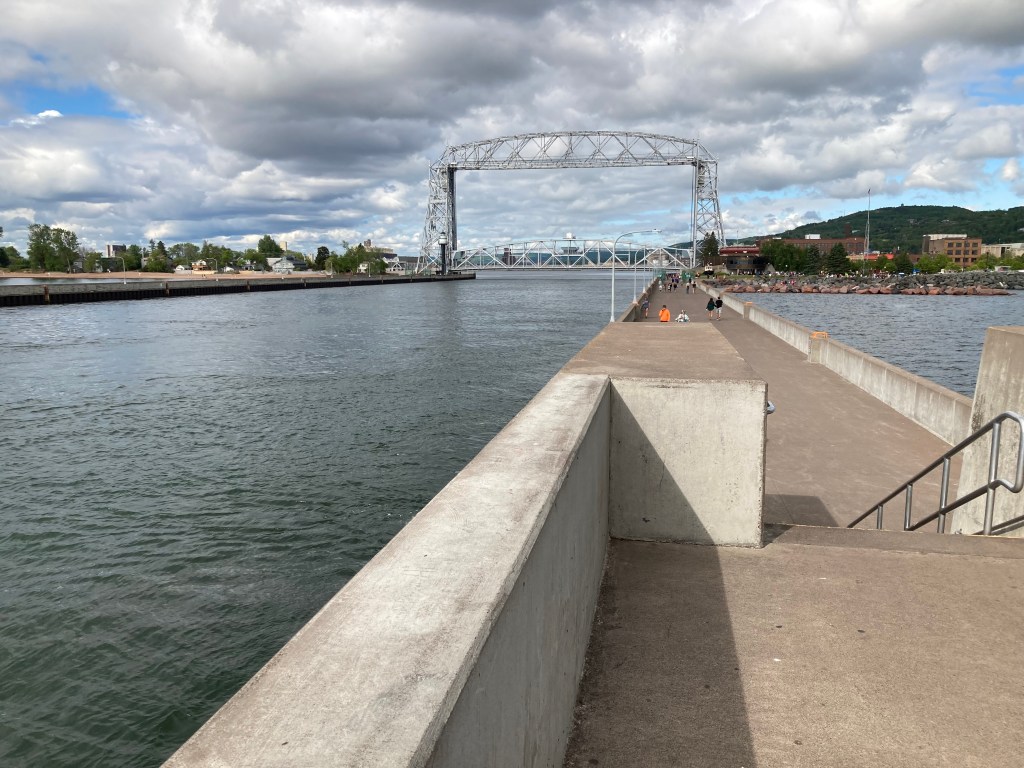
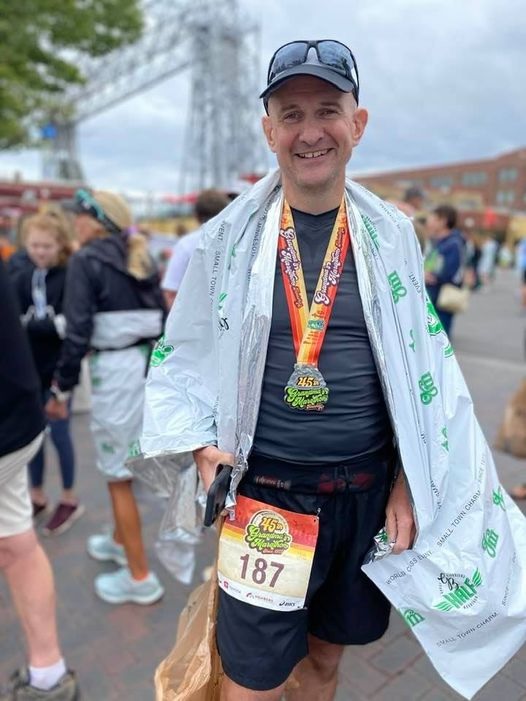
55% of 2021 Grandma’s finishers had Minnesota addresses, which was only slightly higher than 2019 (51%). As usual, many Grandma’s runners traveled a long distance to participate.
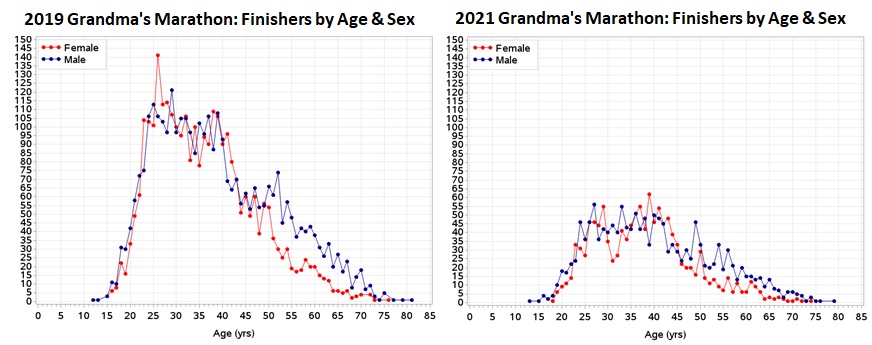
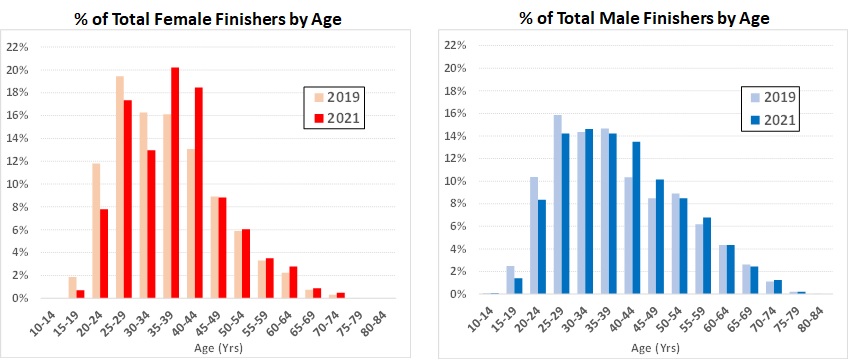
The gender + age distributions of finishers were slightly different in 2021 compared with 2019. The first pair of graphs plots the absolute numbers. The bar graphs below these compare the percentage of females by age group and the percentage of males by age group in 2019 and 2020.
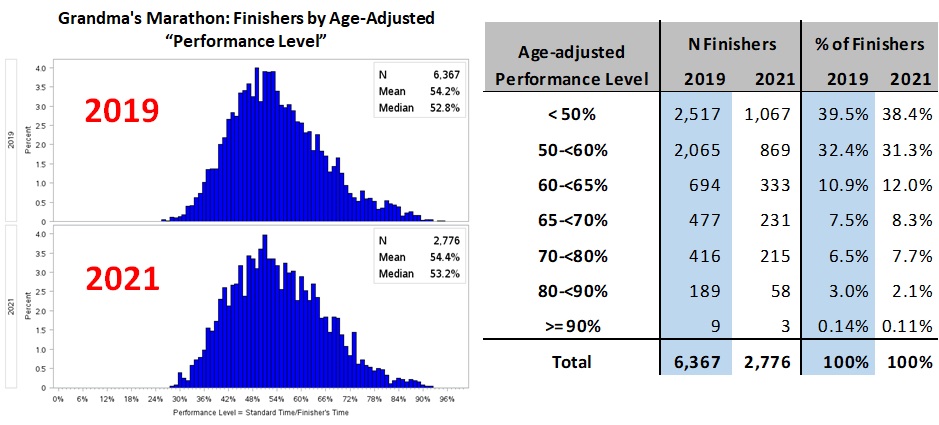
The histograms below compare all finishers in 2021 and 2019 Grandma’s by age-adjusted “performance level” (also sometimes called the “age-graded percent”). The performance level for each runner was calculated using the “age standard times” from USA Track & Field (USATF), which are modeled from world-record times by gender and one-year age group. The distribution of performance times was very similar for 2019 and 2021 races.
For example, the age standard time for a 54-year-old male is 2:21:16 while that for a 42-year-old female is 2:19:09. Mark (54) and Trish (42) had official finishing times of 3:43:38 and 3:46:53, respectively. Dividing their age standard by finishing times yields age-adjusted performance levels of 63.17% for Mark and 61.33% for Trish. The overall first place male was Milton Rotich, a 35-year-old from Kenya who finished in 2:13:04 (91.92%). The overall first place female was Dakotah Lindwurm, a 29-year-old from Minnesota who finished in 2:29:04 (89.94%).
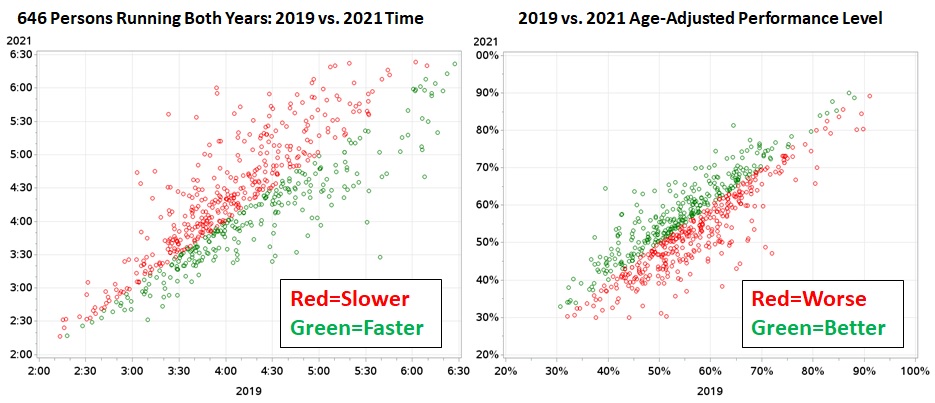
Of the 2,776 Grandma’s 2021 runners, at least 646 (23.3%) also ran Grandma’s in 2019. I identified these by querying for finishers with matching last name, first two letters of first name, and age that was two years older in 2021. The first graph (below) plots these runners 2019 finish time (X-axis) vs their 2021 finish time (Y-axis); the second graph plots age-adjusted performance level (two years of additional age is enough to make a big difference for older runners). 59.6% of the people who ran both years took more time to finish in 2021 (ran slower). The USATF age-adjustment model accounts for some of this difference, categorizing only 53.6% of those running in both years as having lower performance levels in 2021.
Temperature is an important factor in marathon times, but 2019 and 2021 appeared to have similar temperatures. There are a lot of other possible explanations for why some runners have big differences in their times in these two years (e.g., did/ did not train well, injury, bad/good day). Some of these may include phenomena that runners refer to as “blowing up” in a race (e.g., failing due to a too-fast start) or “catching fire” (running surprisingly fast). My conclusion, from this sample of finishers, is that, on average, individuals’ performances were neither better nor worse in this unusual year (training during pandemic, starting the race individually, etc.).
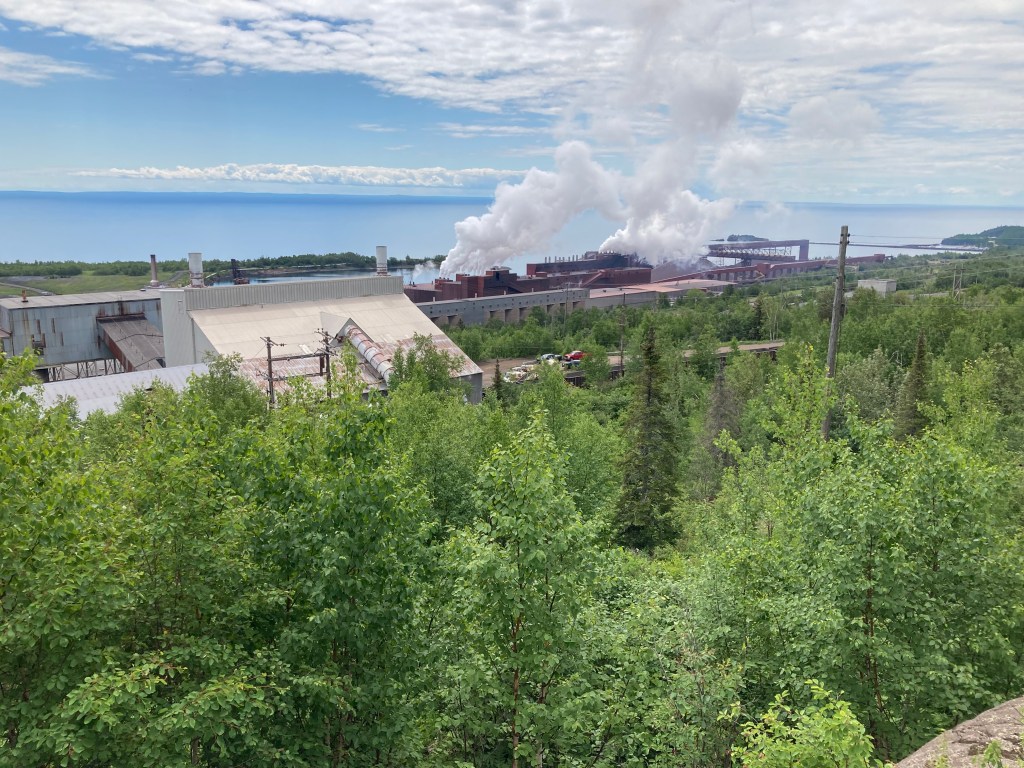
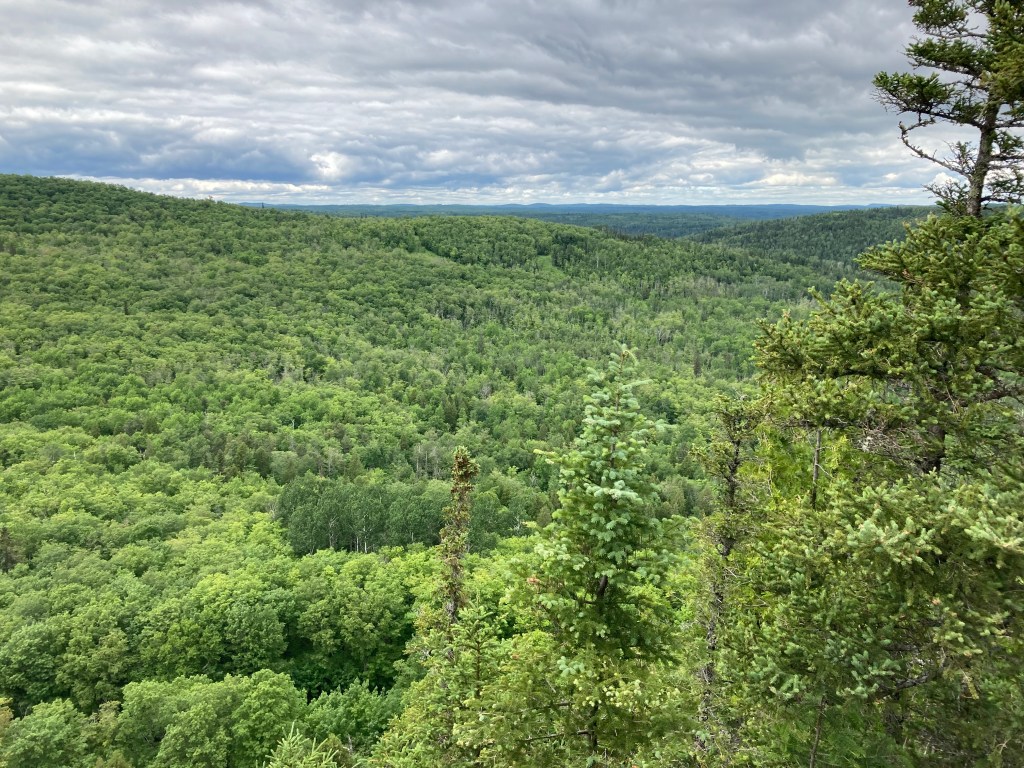
Although I did not get to participate in Grandma’s 2021 as a runner, I certainly experienced lots of “awe” during all of the training runs, the group “pasta dinner” at a local Olive Garden restaurant three days before race day, and observing the special excitement in Duluth surrounding the resumed tradition of Grandma’s weekend. After the race was (mostly) over, I also got a chance to see a bit of the Minnesota North Shore!
 Happy Aging Runner
Leave a comment